
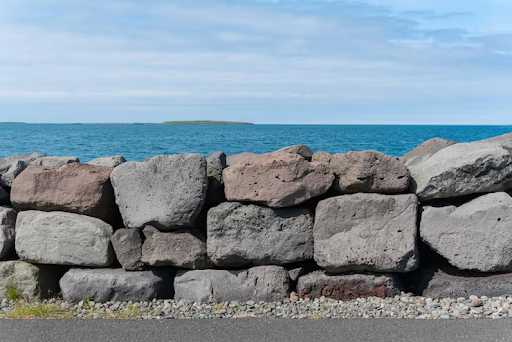
Florida has more miles of coastline than any state in the contiguous United States — over 8,400 miles when you count tidal shoreline, bays, and estuaries. That’s a lot of waterfront property, and a lot of shoreline that needs protecting. For homeowners and businesses in Palm Beach and Martin County, the combination of tropical storms, tidal surges, rising sea levels, and daily wave action from boat traffic puts waterfront land under constant stress. A seawall is the structure that stands between your property and that force.
Understanding how seawalls work, what they’re made of, and when to build or repair one helps you make smarter decisions about one of your property’s most important protective assets.
How a Seawall Actually Works
A seawall is a vertical or near-vertical barrier installed at the water’s edge. Its job is to absorb and deflect wave energy before it can erode the soil behind it. Without that barrier, water gradually saturates and displaces soil, undercutting everything built on top — foundations, landscaping, docks, and hardscaping.
In Florida’s intracoastal waterways and coastal zones, seawalls face specific and demanding conditions:
- Tidal fluctuation that repeatedly wets and dries the base of the wall, stressing materials and mortar joints over time
- Storm surge during hurricane season that can push massive volumes of water inland rapidly
- Boat wake from intracoastal traffic that creates continuous low-level wave action even on calm days
- Soil subsidence common in South Florida’s sandy, limestone-underlain terrain, which can destabilize foundations
- Salt exposure that corrodes metal components and degrades unprotected concrete and wood faster than in freshwater environments
A properly engineered seawall accounts for all of these factors — not just the ones visible on a calm afternoon.
Seawall Materials: What Works Best in Florida
Material selection is one of the most consequential decisions in seawall construction. Each option has different strengths depending on exposure level, soil type, water conditions, and budget.
Vinyl sheet pile is the most widely used material for residential Florida seawalls today. It doesn’t rust, rot, or corrode, and it performs well in both saltwater and freshwater environments. It’s also relatively lightweight, making installation faster and less disruptive. Vinyl walls typically last 25 to 50 years with minimal maintenance.
Aluminum sheet pile offers similar corrosion resistance with added structural rigidity, making it a strong choice in areas with heavier wave energy or where a longer span between tie-back anchors is needed.
Concrete remains the standard for high-exposure coastal locations and commercial applications. Properly reinforced concrete seawalls are extremely durable, though they require periodic inspection for cracking and spalling — especially where rebar is close to the surface and exposed to salt air.
Rip-rap and rock revetments take a different approach entirely. Rather than a vertical wall, rip-rap uses layered native stone to dissipate wave energy gradually. This method is particularly effective for shorelines with gentler slopes and has the added benefit of creating habitat for fish and other marine life. It blends naturally into the environment and is often the preferred solution for ecologically sensitive areas.
Treated wood still has applications in lower-exposure environments, though it has largely been replaced by vinyl and aluminum in most Florida coastal installations due to longevity concerns.
Expert Seawall Marine Services Florida Properties Depend On
Choosing the right contractor matters as much as choosing the right material. Seawall marine services Florida property owners need are shaped by local permitting requirements, coastal construction setback rules, soil conditions specific to South Florida’s geology, and a deep familiarity with how this particular coastline behaves through every season.
Marine Construction Inc. has been operating out of Lake Park, Florida, for over 35 years, serving Palm Beach and Southern Martin County. That kind of local tenure means the team has built seawalls through multiple hurricane seasons, navigated Palm Beach County and Martin County permitting processes hundreds of times, and repaired walls that were originally installed without adequate engineering behind them.
Seawall services cover the full project lifecycle:
New seawall construction — Built from your design or engineered in-house to suit your property’s specific conditions. Every wall is constructed to meet current Florida building codes and designed for long-term performance.
Seawall repair — Seawalls don’t usually fail all at once. They deteriorate through warning signs: horizontal cracking, soil loss behind the wall (known as blowouts), failing tie-back rods, separated cap sections, and undermining at the base. Addressing these early is dramatically less expensive than waiting for structural failure.
Shore restoration and rip-rap installation — For eroding shorelines that need stabilization without a vertical wall, native Florida stone rip-rap barriers control erosion, reduce wave energy, and support local marine ecosystems simultaneously.
Warning Signs Your Seawall Needs Attention
Florida property owners should inspect their seawall regularly and watch for:
- Horizontal cracks running along the face of the wall — a sign of pressure buildup behind it
- Soil or sand washing out at the base or through gaps in the wall panels
- Leaning or bowing of the wall face toward the water
- Rust staining running down from tie-back locations, indicating corroding steel rods
- Settled or cracked cap along the top of the wall
- Erosion on the land side directly behind the wall
Any one of these signals warrants a professional inspection. What appears to be a surface-level cosmetic issue is very often an early-stage structural problem — and the difference between a repair and a full replacement often comes down to how quickly it’s caught.
What a Seawall Protects Beyond the Shoreline
The value of a functioning seawall extends further than most property owners initially consider. Docks, boat lifts, and pilings installed nearby all depend on stable soil conditions at the water’s edge. When the shoreline erodes, dock supports can shift, boat lifts can go out of level, and the entire marine infrastructure becomes compromised from the ground up.
A sound seawall also directly protects property value. Buyers and lenders in South Florida’s waterfront market scrutinize seawall condition closely, and a deteriorating wall can delay or derail a transaction. Insurance underwriters are increasingly factoring coastal resilience into coverage assessments as well, making a well-maintained seawall a financial asset — not just a structural one.
The Bigger Picture for Florida’s Coastline
Seawalls are ultimately part of a larger conversation about how Florida manages its relationship with water. As sea levels continue to rise and storm patterns intensify, the structural integrity of coastal barriers — both public and private — becomes increasingly important to communities up and down the state.
For individual property owners, that translates to a straightforward responsibility: know the condition of your seawall, understand what it’s protecting, and work with contractors who have genuine expertise in Florida’s specific coastal environment. A seawall built and maintained correctly doesn’t just protect one property — it contributes to the stability of the entire waterfront neighborhood around it.
In a state defined by its water, that protection is worth getting right.